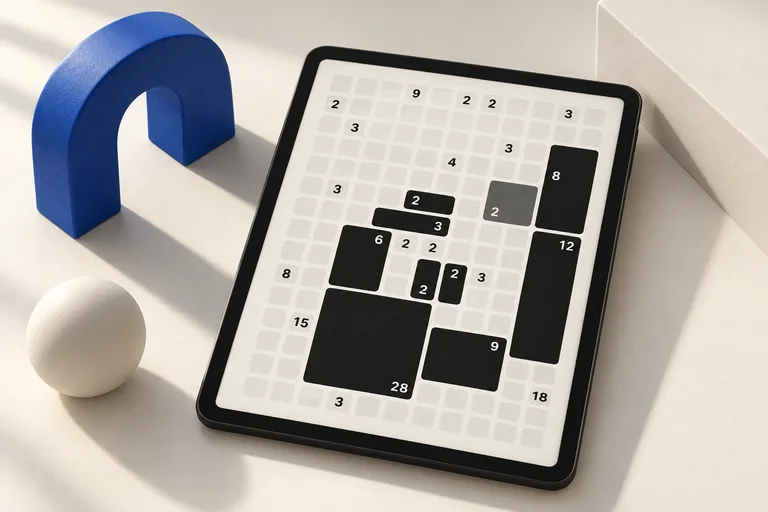


Shikaku is a logic puzzle about dividing a grid into rectangles. The numbers are already there. Your job is to discover the boundaries around them. Sukto brings this idea to iPhone and iPad with touch controls and an introduction to the rules.
The three rules of Shikaku
Each rectangle must contain exactly one number. Its area, measured in cells, must equal that number. Rectangles cannot overlap, and the finished solution must cover the whole grid. A square counts as a rectangle.
A clue of 6 therefore needs six cells. It does not mean the sixth row, a six-cell perimeter or six additional empty cells. The cell containing the clue is already part of the total. These are the core rules described by Nikoli, the publisher behind Shikaku.
Read a number as an area
Before drawing a region, turn its clue into possible dimensions. A 4 could occupy a 1 × 4 strip, a 4 × 1 strip or a 2 × 2 square. Which shapes fit depends on the board, nearby clues and regions you have already established.
The clue does not have to sit in the middle. It can be anywhere inside its rectangle. That matters: a correct shape in the wrong position can block another clue even though its area is right.
Work through a small example
Here is a practice grid with three rows and three columns. Dots represent cells without clues.
4  ·  2
·  ·  ·
·  3  ·
The clues add to nine, matching the nine cells. One solution groups them like this:
A  A  B
A  A  B
C  C  C
Region A is a 2 × 2 square containing the 4. Region B is a vertical 1 × 2 rectangle containing the 2. Region C is a horizontal 3 × 1 rectangle containing the 3. Every cell belongs to one region and every region has just one clue.
Notice why the 4 cannot become a straight strip here: neither dimension of the board is long enough. The board boundary removes both strip possibilities before you draw anything. This is the kind of deduction that makes Shikaku satisfying.

Draw and correct in Sukto
Drag between two cells to preview an axis-aligned rectangle. Release to confirm a legal region. Sukto rejects a selection if it has the wrong area, contains more than one clue or overlaps a confirmed region.
To remove a confirmed rectangle, tap any of its occupied cells. You do not need to tap the number itself. Then try the revised boundary. Corrections are a normal part of learning; accepting one rectangle does not certify that every remaining cell will be solvable without changing it.

Complete the board, at your own pace
The puzzle is finished when every cell is covered by valid rectangles. Ordinary Sukto puzzles have no time or move limit. A clock records your active playing time, while optional Challenges have their own explained conditions.
Start with a small board and ask one question at a time: which clue has the fewest possible rectangles? Once the basics feel familiar, explore our Shikaku solving strategies or review common rectangle mistakes. You can also learn more about Sukto.