

A Shikaku board can look nearly finished while hiding a small counting or placement error. When a rectangle does not work, check the rule it violates before changing unrelated regions. Here are seven mistakes worth learning to recognize.
1. Counting only the empty cells
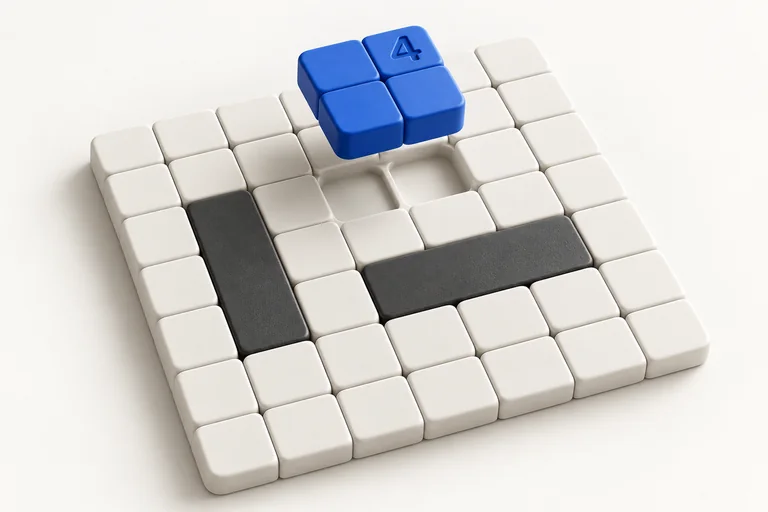
A clue of 4 requires four cells in total, including the numbered cell. Adding four empty cells around it creates an area of five. Count every cell inside the boundary exactly once.
A quick check is width multiplied by height. A rectangle two cells wide and two tall has area four, regardless of where its clue sits.
2. Drawing a shape that is not a rectangle
An L-shaped group can contain the right number of cells and still be invalid. Shikaku regions must be rectangles aligned with the grid. Squares are allowed; bent or disconnected shapes are not.
When checking a candidate, imagine the full box between two opposite corners. All cells in that box belong to the proposed region. There cannot be a missing corner or a hole.
3. Assuming the clue marks the center
Numbers identify area, not the center of a region. If you always place a clue in the middle, you may overlook the solution sitting next to it.
For a 2 × 3 region, the number could occupy any of its six cells. Check placements with the clue near an edge before dismissing that shape. Our strategy guide explains how boundaries reduce those options.
4. Including a second clue
Two numbers inside one rectangle do not combine into a larger clue. Every region contains exactly one. Even if their sum matches the area, the selection breaks the puzzle’s structure.
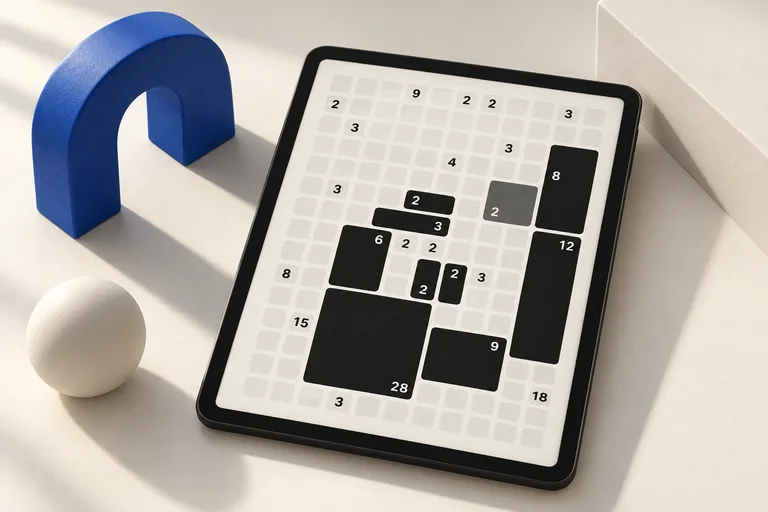
In Sukto, a drag preview may pass over another number while your finger is moving. The release must still form a valid region; a preview is not a promise that the selection will be accepted.

5. Treating an accepted move as a solved deduction
Sukto checks whether your rectangle is legal where you drew it. That is different from proving the rest of the board can be completed with that choice fixed.
If the remaining space stops making sense, review an earlier rectangle you placed tentatively. Tap any occupied cell in that region to remove it. Reconsidering a move is part of solving, not evidence that the puzzle is broken.
6. Leaving a cell with no possible owner
A tiny isolated gap is easy to miss. Before drawing the last few regions, scan every empty cell and ask which remaining clue could reach it with a rectangle.
If none can, the gap cannot stay. At least one neighboring region needs a different boundary. Counting the total unfinished area can also reveal that your current assumptions do not fit.
7. Trying to beat the clock while learning
Ordinary Sukto puzzles record time without imposing a deadline. You can pause, return and think through a correction. Optional Challenges explain their own restrictions separately.
Early on, a better goal is being able to explain why a rectangle belongs where you placed it. Speed may follow familiarity, but it is not a requirement for completing the board.
For a clean restart of the fundamentals, follow our small Shikaku example. It shows exactly how three numbered regions cover a nine-cell board. Learn more about the app on the Sukto page.